Work of the month - Jan van Huchtenburgh
March 2025
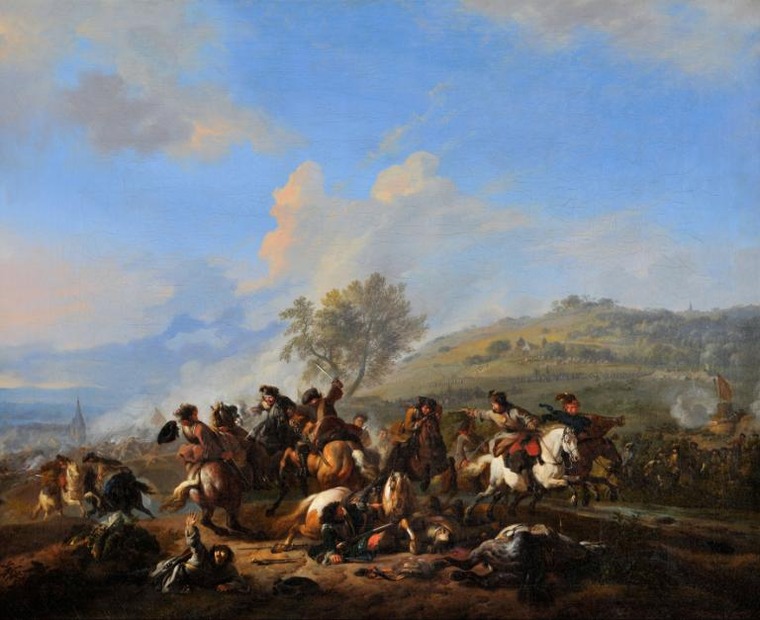
A battle on the plains of Fleurus. A fragment of universal history
Jan van Huchtenburgh (Haarlem 1647- Amsterdam 1733)
‘A Battle on the Plains of Fleurus’, undated (between the 2nd half of the 17th century and the 1st half of the 18th century)
Oil painting on canvas
64.5 x 78 cm
Acquired in 1930 by the City of Liège
We have not forgotten that history tirelessly repeats itself. As a prelude to the ‘Ars Mechanica’ exhibition, which opens at the Musée de La Boverie on 25 April to mark the 135th anniversary of the Fabrique Nationale de Herstal (an arms company now renamed FN-Browning Group), we are giving pride of place to this undated battle scene from the very late 17th or early 18th century.
A pictorial genre in its own right, battle scenes have existed since time immemorial, dating back to Antiquity, but it was from the 17th century onwards that they developed considerably, in all the arts - painting, sculpture and literature. War is a (sadly) major event in a civilisation. For propaganda purposes, edifying images were produced that would live long in the memory.
Depending on the situation, the artist may have been commissioned to produce a detailed description of the topography of the area in order to evoke a specific historical event. In many other cases, it was a case of ‘genre battle paintings’, imaginary scenes mass-produced on the market, small formats intended for a bourgeois clientele. The viewer is at the centre of the tumult, the soldiers are anonymous, and the battle is presented in a very expressive way.
Jan van Huchtenburgh made battle paintings his speciality. After studying in Haarlem in the studio of Thomas Wyck (1616-1677), a stay in Rome gave him a taste for painted landscapes. In 1667, he continued his training in Paris at the Manufacture des Gobelins (a large tapestry factory created in 1601 at the instigation of Henri IV and still in operation today) and returned to his native town in 1670, where he ran a painting shop and joined the Guilde de Saint-Luc, a guild of artists and craftsmen.
In 1708, he entered the service of the Austrian prince Eugène de Savoie-Carignan, whose campaigns he followed (most of the paintings from this period are in the Saubauda gallery in Turin). After 1717, van Huchtenburgh joined the court of the Elector of the Palatinate, Jean Guillaume de Neubourg, and became a recognised artist.
His excellent style was influenced by two battle painters, the Dutchman Philips Wouwerman (Haarlem 1619-1668) and the Flemish Adam François van der Meulen (Brussels 1632 - Paris 1690), who were themselves influenced by their predecessor, Sebastian Vrancx (Antwerp, 1573-1647), considered to be the precursor of the genre in the Southern Netherlands. Jan van Huchtenburgh is renowned for his virtuoso portrayal of horses, his rendering of the tumult of the confrontation, its dynamism and violence.
This is the effect of ‘Battle on the Plains of Fleurus’. In the foreground of the painting, a battle scene painted in dominant reds and dark browns with patches of light that draw the eye to certain areas. The chiaroscuro effect is combined in the upper part with vegetation in a monochrome of greens against a clear sky. The image seems to have been taken on the spot, with the characters, whose faces are barely individualised, expressing above all effort and brutality in a certain baroque theatricality. The soldiers on horseback are fighting with swords and pistols, a horse has fallen on one of the belligerents, and we see the wounded with haggard eyes, including one figure, with a look of fear in his eyes, who raises his hand to call for help. The painting is energetic, the horses, with their imposing rumps and shaking tails, and the horrified expressions of the figures plunge us into a particularly dramatic moment. On either side of the scene, we can make out large troops in the background. A church tower on the left indicates the presence of a village, and on the right we can see small tents, probably those of a military camp, whose flags are not distinct. The upper part of the canvas consists of a summer landscape, in an atmospheric perspective, with a large tree in the centre of the plain.
Was this battle imagined by Jan van Huchtenburgh or does it evoke a historical event? There have been several battles on the plains of Fleurus, in what is now Hainaut, and we have no date for this work. There was a ‘Battle of Fleurus’ in 1622 (painted in 1634 by Vincenzo Carducci and now in the Prado Museum), but it pre-dates our Dutch artist. Nor should the title of van Huchtenburgh's painting be confused with the famous ‘Battle of Fleurus’ of 26 June 1794, during the First Coalition war between the coalition forces and France.
However, it could be an episode from the Battle of Fleurus on 1 July 1690, a victory by the French army commanded by Marshal de Luxembourg against the armies of a broad European coalition comprising the United Provinces, the Imperials, Spain and England led by the German general Waldeck. On 1 July in Fleurus, France won a resounding victory, this battle being one of the episodes in the War of the League of Augsburg, also known as the Nine Years' War, from 1688 to 1697. Ironically, Louis XIV had hoped for a swift resolution to the conflict, which ended up being a long war of attrition... any resemblance with the situation today would not be accidental! In relation to the painting before us, the verdant landscape and the scene in the foreground, where the grass on the ground seems to have dried, indicate that this battle could have taken place in July.
Whether real or imagined, the battle scene reminds us that there have been, are and will continue to be armed conflicts, and with them weapons, ever more sophisticated and ever more deadly despite supposedly surgical strikes. Contemporary artists, film-makers, photographers and writers continue to evoke this theme. For my part, it's the peaceful upper part of Jan van Huchtenburgh's canvas, the blue sky with a few cumulus clouds, that catches my attention: I think of Prince Andrew in Tolstoy's ‘War and Peace’, wounded in the head, lying on his back on the grass at Austerlitz and looking up at the sky: ‘How could I not have seen this high sky earlier? And how happy I am to know it at last. Yes! everything is vanity, everything is a lie, except this infinite sky’.
Emmanuelle Sikivie
Art historian
Specific attaché
La Boverie - Museum of Fine Arts