work of the month - Guillaume Corneille
September 2025
Guillaume Corneille (Liège, 4 July 1922 – 5 September 2010)
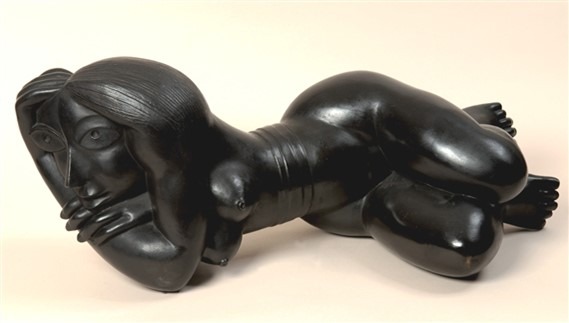
Mounira or the theme of the Black Venus
Mounira, bronze, 1999
Inv. BA.AMC.02c.2024.008447
Acquired by the City of Liège from the Corneille Foundation in 2024.
To mark the 15th anniversary of the painter's death, La Boverie is inaugurating a new sculpture by Liège artist Guillaume Corneille (1922-2010) this September. A protean artist and founder of the international CoBrA movement, Guillaume Corneille was a world traveller who distinguished himself early on by his love of travel.
Fascinated by the writings of Michel Leiris and the first film reports on Africa, the painter first travelled to Tunisia in 1948 to follow in the artistic footsteps of Paul Klee. In 1951, he travelled through the Hoggar desert and, for more than a decade, developed a style of mineralogical landscape painting that reflected his impressions of the landscapes he had traversed. Together with Pierre Alechinsky, he produced a series of etchings in Stanley William Hayter's studio, reinterpreting in an abstract language the first writings of the desert (1953), discovered two years earlier. The years 1956 and 1957 were marked by one of his most ambitious projects, in which he travelled with his first wife, photographer Henny Riemens, across Africa from west to east, starting from the Niger River. Part of his Ethiopian journal was reproduced in 1959 in a contemporary art magazine, Cahiers du Musée de poche, illustrated by Pierre Soulages.
Mounira is derived from the Arabic word ‘nour,’ which means ‘light.’ Both a real model and an allegory of a beloved continent, a prodigious land of suns and humanity, Guillaume Corneille abolishes the boundaries of cultural geographies. A profound humanist, he celebrates this ‘civilisation of the Universal’ championed by his friend, the poet and first President of the Republic of Senegal, Léopold Sédar Senghor, whose works he has been illustrating since the 1970s.
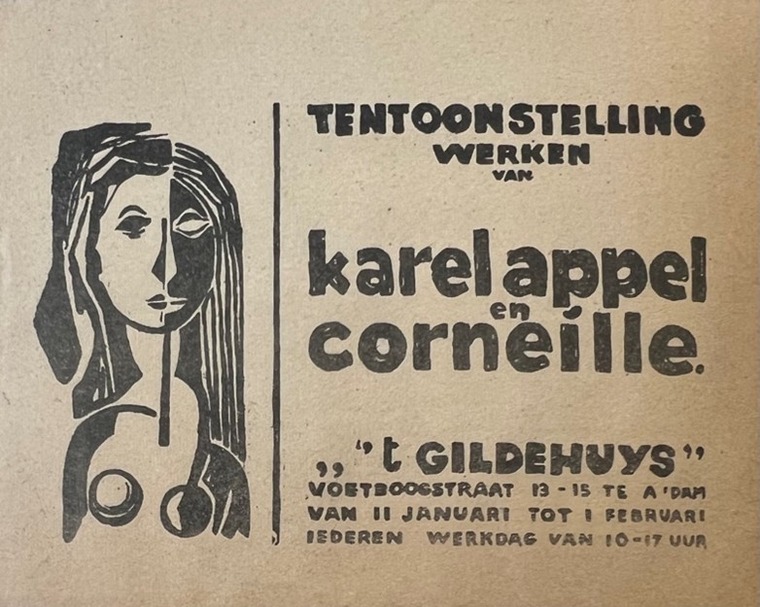
In January 1947, for his very first exhibition, he created a portrait of a hybrid woman, half black, half white, with angular lines inspired by Cubist forms. It is astonishing to discover the perfect continuity and lineage between two works separated by more than fifty years. Mounira is a bronze sculpture from 1999, created seven years after a new journey across Africa organised for television.
Guillaume Corneille develops the body in several facets here, so that it is necessary to move around and walk around the sculpture to understand the balance achieved by the painter. Dominated by a synthetic vision of lines, the work is reminiscent of certain ancient sculptures. Mounira is like Venus, goddess of love and beauty, extracted from another time.
A polyglot who playfully puns on the literal meaning of his name, ‘I am a free bird in the sky,’ Guillaume Corneille is one of the few modern painters to have travelled through so many African countries. His journey also took him to America and Asia. Throughout his travels, his painting offered, in both abstraction and figuration, a non-ethnocentric art that simply celebrated the vitality and joy of being alive. Wasn't one of his artist's books in 1973 entitled Corneille and Life?
Present on several artistic stages around the world, each work is an invitation to discover others and, in this dialogue with different cultures, reveals what a writer he has brought to life in images called ‘the joy of being together’:
‘The pride of being different should not prevent the happiness of being together.’
Aimé Césaire
Cédric Pernot
Director of the Guillaume Corneille Foundation