Artwork of the month - GILBERT & GEORGE
June 2025
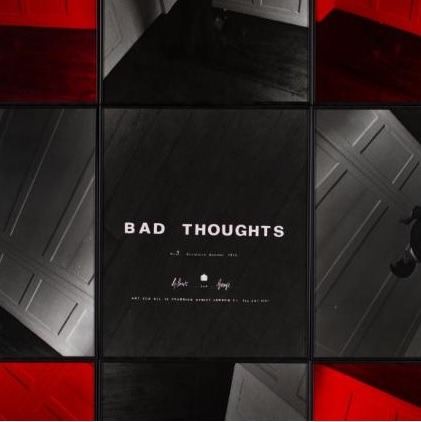
GILBERT & GEORGE (Gilbert Proesch and Georges Passmore dits) San Martino (IT), 1943 and Plymouth (GB), 1942.
Bad Thoughts/N°3
1975
Photographs
Gilbert and George can be regarded as representatives of the behavioural art that has its roots in the work of Marcel Duchamp and from which Body art* and Fluxus* derive.
Their slogan ‘art for everyone’ is similar to Fluxus' ‘everything is art’.
Their aim was to remove the boundaries between art and life, to represent the content of humanity in a universal way by placing themselves in their immediate environment.
The smallest gestures in their lives became pretexts for creation. They recuperate the everyday, even the banal, transferring habits and attitudes from their private lives into the realm of art, their bodies becoming the plastic material of ‘living sculptures’.
It was in 1967, at St Martin's School of Art in London, that the young Englishman George met Gilbert from Italy. Both from humble backgrounds and gay, they felt different.
In 1968, they moved to the working-class East End, where they rented a ground-floor flat within their limited means and presented their first work, which they entitled ‘Living Sculpture’. They remained united, on stage and off, in their art and in their lives. They gave numerous performances, including the famous ‘Singing sculpture’ in 1970, always using their bodies as the main sculptural material. Having become public figures, they built up a look of well-dressed, somewhat old-fashioned bank employees, always impassive, their appearance contrasting with their destitute lives at the time, rubbing shoulders with tramps and drunks.
From 1974 onwards, they began to use photography, reducing the range of colours to black, white and red in photomontages organised in rectangular grids, often forming crosses, reminiscent of cathedral stained-glass windows. It was at this time that they bought the house from which they had previously rented the ground floor. The house was in a state of disrepair and renovation work would be painstaking. It was at this point that they began to take photos of empty rooms in which they depicted themselves alone and melancholy.
Bad Thought/n°3 is part of a series of photomontages, number 7 of which features in the Pinault collection, produced during this dark period in their lives, when they gave in to alcoholism in particular. The title means ‘Bad thoughts’, and this is exactly what they were experiencing in 1975. A set of 9 silver photographs, 4 of which are hand-coloured, showing the wooden floors and panelling of empty rooms. In four of them, the two artists appear full-length, rigid and immobile, posing facing the wall, right-side up or upside down, cigarette and glass in hand, staged with humour and derision. The red colour of the four corner panels adds a dramatic effect and highlights the cross, an organisation that will be dear to them, formed by the four panels where the artists are present. The centre panel - like an advertising poster - bears the title, the subtitle ‘Sculpture Summer’, their slogan ‘Art for all’, their signatures, address and telephone number.
From 1977 onwards, they ceased their social life and concentrated on their work at home, where they had set up their studio.
Françoise Safin
Honorary Curator / Musée des Beaux-Arts de Liège
- Body art
Pitting their ego and their solitude against reality, these artists use their own bodies as a means of artistic production, turning them into works in their own right and allowing them to be modified or altered.
- Fluxus
Fluxus is a collective, international and interdisciplinary movement, using all technical means to combine art and life. For these artists, it was a question of manifesting their presence, their energy, in the context of reality in order to achieve ‘total art’.