work of the month - Edgard Tytgat
April 2025
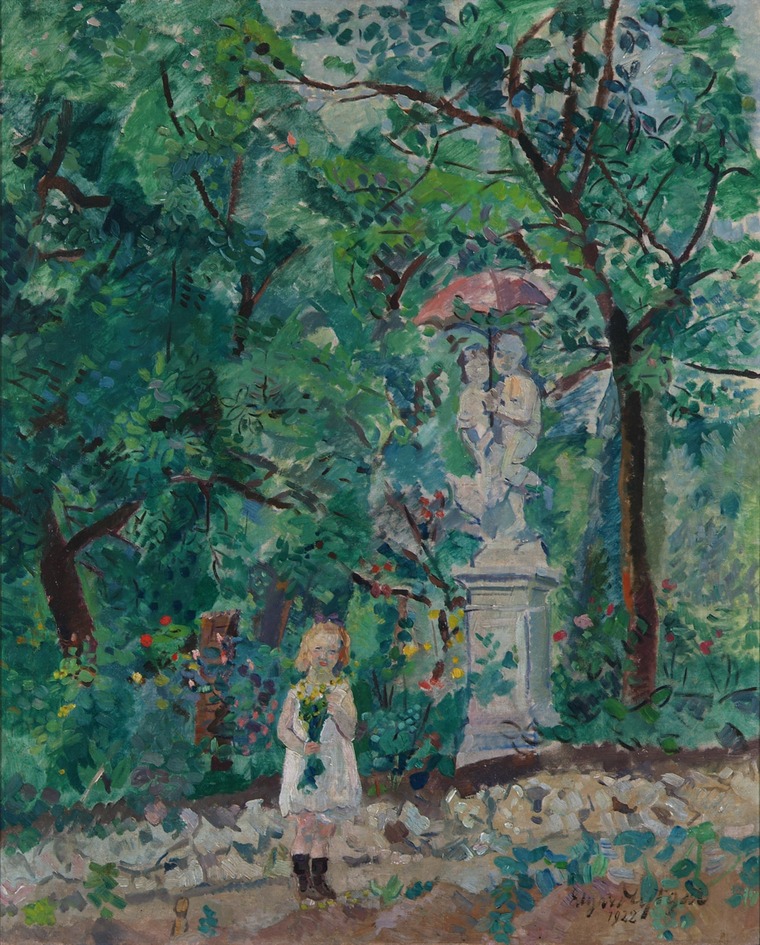
Snapshot of a garden corner
Edgard Tytgat (Brussels, 1879 - Woluwe-Saint-Lambert, 1957)
A corner of the garden in Nivelles 1922
Oil on canvas, 100 x 81 cm
Inv. BA.AMC.05b.1922.21787
Government deposit in 1922
Edgard Tytgat was an observer, deeply rooted in city life, contemplating the theatre of everyday life from his window. He drew his inspiration from fairs, funfairs and carousels, as well as scenes from the Brussels suburbs, the backdrop to much of his life and an inexhaustible source of his imaginative tales.
Born in Brussels in 1879, Edgard Tytgat grew up in Bruges before returning to his native city in 1888. He learned lithography with his father and entered the Brussels Academy of Fine Arts in 1900. Married in 1905 to Maria Demesmaeker, who was to become his favourite model, and living in Watermael from 1907, he became a close friend of the painter Rik Wouters. Together they discovered Bonnard and Vuillard, figures of the Nabis movement. War separated the two in 1914, when Wouters was interned in Holland, where he died two years later. Meanwhile, in exile in England, Tytgat devoted himself to book illustration and produced a number of works in the Impressionist movement, characterised by his characteristic light-heartedness. Moved by the death of his friend, he dedicated a collection of engravings to him, published in 1917 (1).
He returned to Belgium in 1920 and settled permanently in Woluwe-Saint-Lambert with his wife in 1923. His style, initially made up of delicate brushstrokes, evolved into large expanses of colour and became part of the expressionist movement. He travelled to Austria and Italy, before dying at the age of 78 in 1957.
This Garden Spot in Nivelles is a perfect illustration of the artistic explorations that inspired him when he created it in 1922, as well as his talent for storytelling. Among the trees and lush vegetation, a blue sky is discreetly revealed. Standing out against the greenery is a sculpture of two children, Paul and Virginie, sheltering under a red umbel on an imposing plinth.
In the foreground, attention is drawn to a little girl wearing a white dress and black boots, a reminder that the scene takes place in fine weather. In her hand, she holds a bouquet of yellow flowers picked from the garden, and stares at the viewer in a frozen pose, like the model in a photograph. A snapshot.
Made up of small, juxtaposed splashes of colour, the different tones of which create a play of light, the palette is dominated by green over three-quarters of the composition, with grey, blue and brown making up the rest. Small patches of red, yellow and pink reveal flowers. The drawn line is left aside to emphasise a live painting of an open-air scene. All these characteristics bring the work closer to the Impressionist style and the artist's pictorial research at the time.
The title, Un coin de jardin à Nivelles, locates the scene in the town where the artist was working at the time, in a wallpaper factory as artistic director. Keen to tell stories, he incorporated into this garden the narrative element of the scene playing out before his eyes: the little girl. ‘This little girl was passing by with her bouquet of flowers, and he immediately called her over and said, ‘Stay there for a while, my little girl’,’ recalls his wife (2).
It's a world of children's dreams that Tytgat tells us about in his work. A poetic universe, peopled with a variety of references and tinged with mischief. Described as a naïve painter, Tytgat is a storyteller of memories, inhabited by benevolent, joyful characters; even if sometimes, in the light of all his creations, some people see darker subjects than they appear. An excellent painter with a varied output, he mastered several techniques while retaining his recognisable style.
The Musée des Beaux-Arts collection contains several works by the artist, including a view of the Sainte-Croix church in Liège, painted during his stay in the Cité ardente between 1932 and 1933, and a large-format painting on eglomised glass, Le Printemps, from 1952.
Laura Dombret
Art Historian
Specific attaché
La Boverie - Museum of Fine Arts
Notes :
(1) Quelques images d'une vie d'une artiste, 1917 (https://www.mskgent.be/fr/collection/2003-az-7)
(2) Report produced by the Service littéraire de la R.T.B., Maria mon cœur ou Les Songes d'Edgard Tytgat, directed by Lucien Deroisy, 1972, extract at 12'55‘’. Online: https://www.youtube.com/watch?v=rPJNiPa-_zE&t=2s
Bibliography:
Régine Rémon and Alain Delaunois (eds.), ‘Edgard Tytgat’, in Catalogue des collections du musée des Beaux-Arts de Liège, vol. II, Liège, 2018.
Régine Rémon, in ‘Un siècle de peinture belge. Rencontre de deux collections’, Liège.museum no. 26, Musée des Beaux-Arts, Liège, September 2014, p. 32-33.
Albert Dasnoy, with the collaboration of Gisèle Ollinger-Zinque, Edgard Tytgat. Catalogue raisonné de son œuvre peint, Editions Laconti, Brussels, 1965.