Work of the Month - E.L.T. Mesens
December 2024
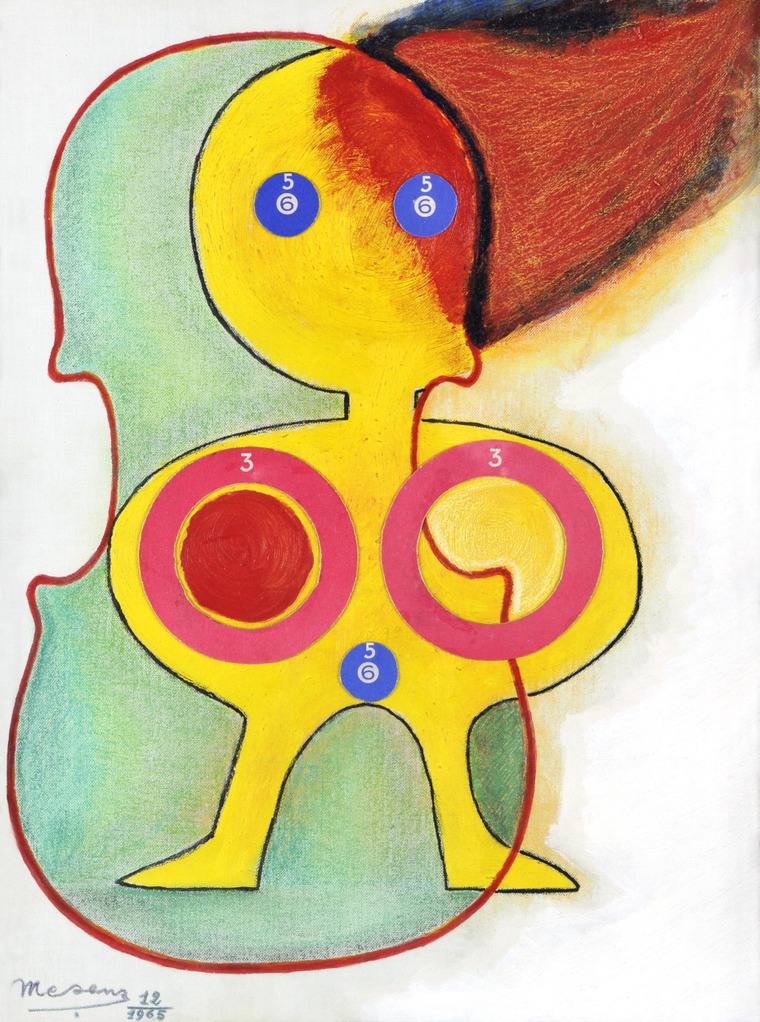
THE SURREALIST SCORES OF E.L.T. MESENS
Edouard Léon Théodore Mesens, known as E.L.T. Mesens (Brussels, 1903 - 1971)
Les violons verts violent aussi bien que les violons noirs (II), 1965
Mixed media on canvas
60 x 50 cm
Signed, numbered XII and dated 1965 lower left
Also titled and signed on the back by the artist
Acquired in 1972 by the Communauté française - Inv. CF10724
On deposit at the Musée des Beaux-Arts de Liège
BA.CED.05b.1972.003994
The year 2024 marks the centenary of the publication of André Breton's Manifesto of Surrealism and the birth of Surrealist activity in Belgium around Paul Nougé. La Boverie's collections include many works by Surrealist and related artists (Magritte, Mariën, Graverol, Stas, Delvaux, Hérold, etc.), as well as a significant work by E.L.T. Mesens (1903-1971), presented as part of the Work of the Month programme.
Often dubbed the ‘one-man band’ of Belgian surrealism, Mesens played a major role alongside Magritte, Nougé and Scutenaire. He was a Dadaist poet, musician, polemicist, creator of avant-garde magazines and publisher, photographer, collagist, exhibition organiser, gallery owner and collector. He contributed greatly and with unbridled passion to making Magritte's paintings better known, as well as those of Delvaux (who was not a member of the Surrealist group). He also played an active role in the internationalisation of the movement, in Brussels as well as in London, Paris and Italy. These activities are now widely documented (1).
Mesens, an impetuous young Dadaist, wanted to emerge first and foremost as a composer and musician, under the aegis of his master of irony and modernity, Erik Satie, with whom he maintained friendly links. This led to articles, correspondence and even a lecture by Satie in Brussels, subsequently published by Mesens in 1924 (2). The Belgian Surrealists, including Nougé - his first wife Paulette Deschamps was a singer and pianist - paid close attention to music, and included André Souris, Paul Hooreman, Paul Magritte... and Mesens, who however, not finding enough recognition, turned to avant-garde photography.
In 1928, while still involved in the Surrealist adventure, he organised an exhibition at the L'Epoque gallery in Brussels, long forgotten by historians, bringing together around one hundred and fifty works by numerous international photographers - even before the exhibitions considered pioneering in Essen and Stuttgart in 1929 - and then a second, at the Palais des Beaux-Arts in Brussels, in 1932. It was Erik Satie who, in 1921, took Mesens to Man Ray's first Paris exhibition, having just arrived from the United States. From then on, Mesens' artistic creation turned towards photography, photomontage and collage on paper. However, these activities remained only a peripheral part of his life until 1950, the eclectic ‘one-man band’ having taken over from the 1930s in Belgium, then in London, and again in Belgium (3).
In the mid-1950s, Mesens suffered from the lack of renown of his artistic creations in the face of the growing popularity of the works of Magritte and Delvaux, whom he had helped to discover and recognise. He therefore returned to the creative practice of collage, combining cut-out coloured shapes, words, numbers, bits of sentences and disparate elements, which he composed and adjusted very precisely, on various supports, paper, kraft cardboard and canvas, often enhanced with oil paint, gouache or pastel. Mesens is meticulous, numbering each piece in the order in which it was created, and by year. The titles he chooses are a play on words, a double entendre, a spoonerism. The closest thing Mesens has to an artistic connection with his collages is Kurt Schwitters, whom he also exhibited and made known.
In Les violons verts violent aussi bien que les violons noirs, work no. 12 (mixed media) from 1965, the title, deliberately absurd but also provocative in its sexual reference, would no longer be accepted today. At the time, he was imposing a Dadaist principle of equivalence, which can be linked to the Fluxus movement, Robert Filliou and his Bien fait, mal fait, pas fait of 1968: everything is equal. The work itself also bears witness to the influence of music, with the curves of a violin (regularly used in other collages) and the outline of a female body, reminiscent of Le Violon d'Ingres, the famous portrait of Kiki by Man Ray in 1924. Other parts of the work use vividly coloured elements that are frequent in the artist's work, such as the circles of a target, or numbers - here, 6 and 5, alluding to the year in which the work was made, 1965. Mesens himself describes his creations as ‘visual poems’, and is fully aware, through this practice that he declares to be ‘anti-style’, that his images and words are part of the plastic language of the avant-garde artists of the 20th century.
Alain Delaunois
Scientific Attaché / La Boverie - Musée des Beaux-Arts
BIBLIOGRAPHICAL NOTES
1. The alphabet of stars by E.L.T. Mesens. Dada and Surrealism in Brussels, Paris & London, exhibition catalogue (ed. Phillip Van den Bossche), Ostend, MuZee, 2013.
Histoire de ne pas rire. Le surréalisme en Belgique, exhibition catalogue (dir. Xavier Canonne), Brussels, Bozar, Ed. Fonds Mercator/Bozar Books, 2024.
2. On Mesens and music, see E.L.T. Mesens, Moi je suis musicien. Ecrits sur la musique réunis par Robert Wangermée, Brussels, Didier Devillez Publisher, 1998.
3. Christiane Geurts-Krauss, E.L.T. Mesens, l'Alchimiste méconnu du surréalisme, Brussels, Labor/Archives du futur, 1998.