Work of the month – Joachim Patenier
December 2025 – January 2026
Restoration of a Saint Jerome in a Landscape
Attributed to the circle of Joachim Patenier
This work, attributed to Joachim Patenier (c. 1480–1524) or his circle, underwent extensive study and restoration in 2024–
2025 as part of a collaboration between the École nationale supérieure des arts visuels de La Cambre and the Musée des Beaux-Arts in Liège.
The treatment was entrusted to Esther Esch, a Master's student in conservation-restoration of easel paintings, under the supervision of Audrey Jeghers, the museum's curator-restorer, and professors from La Cambre.
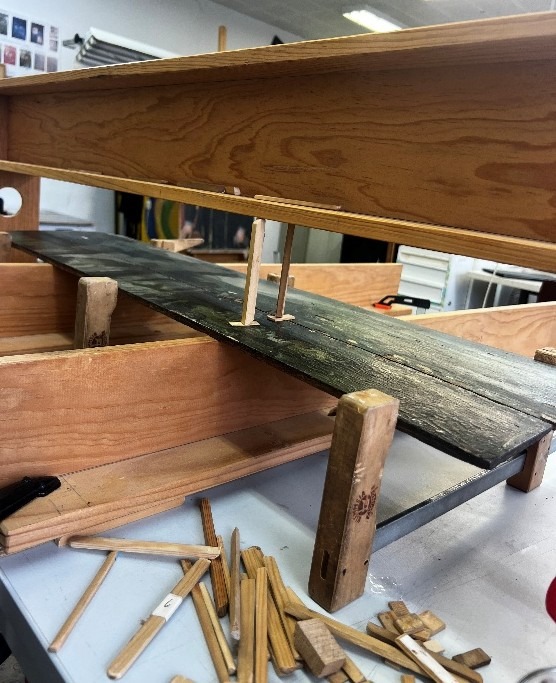
Kept in the museum's storage facilities, the work was in poor condition: the panel was broken into three pieces and the paint had been locally reattached. Before any work was carried out, a series of observations and analyses were conducted in order to understand the painting technique and the material history of the painting.
The work is painted in oil on oak panel. Stylistic and technical analyses place it in the circle of Joachim Patenier. We find the artist's characteristic features: a composition structured in three hierarchical planes according to an atmospheric perspective, a foreground dominated by green with a blue background, a rocky landscape inspired by the Meuse valley and small figures inserted into the immensity of the landscape. These stylistic details are consistent with other works attributed to the Dinant master, notably Saint Jerome in Penance in the Desert (1521, Louvre Museum).
A stratigraphic analysis, conducted in collaboration with the Royal Institute for Cultural Heritage (IRPA-KIK), revealed the presence of the blue pigment azurite, a rare and expensive material commonly used by the Flemish masters.
The physical examination revealed numerous alterations: fractures in the support, lifting of the paint layer, wear and oxidation of the glazes, as well as two layers of yellowed varnish that obscured the surface. Old overpainting, applied to conceal gaps, altered the composition in places, particularly in the sky. Despite this damage, the original paint layer was found to be remarkably well preserved, testifying to the quality of the work's execution.
The treatment therefore focused on stabilising the support and the paint layer, followed by a gradual lightening of the varnishes and the complete removal of the overpainting. The areas with gaps were retouched in a reversible manner without overflowing, in order to restore the legibility of the composition while respecting the materiality of the original painting.
In the absence of the original frame, a new frame was designed and adapted to the natural curvature of the panel, meeting both conservation requirements and enhancing the aesthetic appeal of the restored work.
Through this research and restoration work, the painting has been rediscovered in all its pictorial coherence and placed back in the artistic context of the first half of the 16th century, at the heart of the evolution of Flemish landscape painting initiated by Joachim Patinir.
Esther Esch
Graduate student in conservation-restoration of works of art at ENSAV La Cambre in June 2025