Work of the month – Carmen Defize
May 2026
CARMEN DEFIZE
AN ARTIST OF MATTER AND THE UNCONSCIOUS
Carmen Defize (Ougrée, 21 February 1917 – Herstal, 1 March 2006)
Virgin and Child (or Tenderness), 1966
Oil on canvas
Dimensions without frame: H. 100 × W. 80 cm
A 212/1988; GC.REL.05b.1988.30210
Gift of the artist
Grand Curtius Museum – Department of Religious Art and Mosan Art
Carmen Defize
From childhood, Carmen Defize showed a strong aptitude for drawing. Between 1934 and 1937, she studied at the Royal Academy of Fine Arts in Liège, where she attended the classes of Auguste Mambour and Adrien Dupagne. After completing her training, she expressed her talents through painting, drawing and watercolour.
In Belgium and abroad, the artist exhibited both individually and collectively, notably with the Association pour le Progrès intellectuel et artistique de la Wallonie (A.P.I.A.W., founded in 1944) and the Brussels-based international artistic and literary group Fantasmagie (active from 1959 to 1979).
The figurative painting of her early years underwent a transformation, and her increasingly expressive artistic vocabulary expanded through experimentation. Her approach is profoundly shaped by a long inner journey.
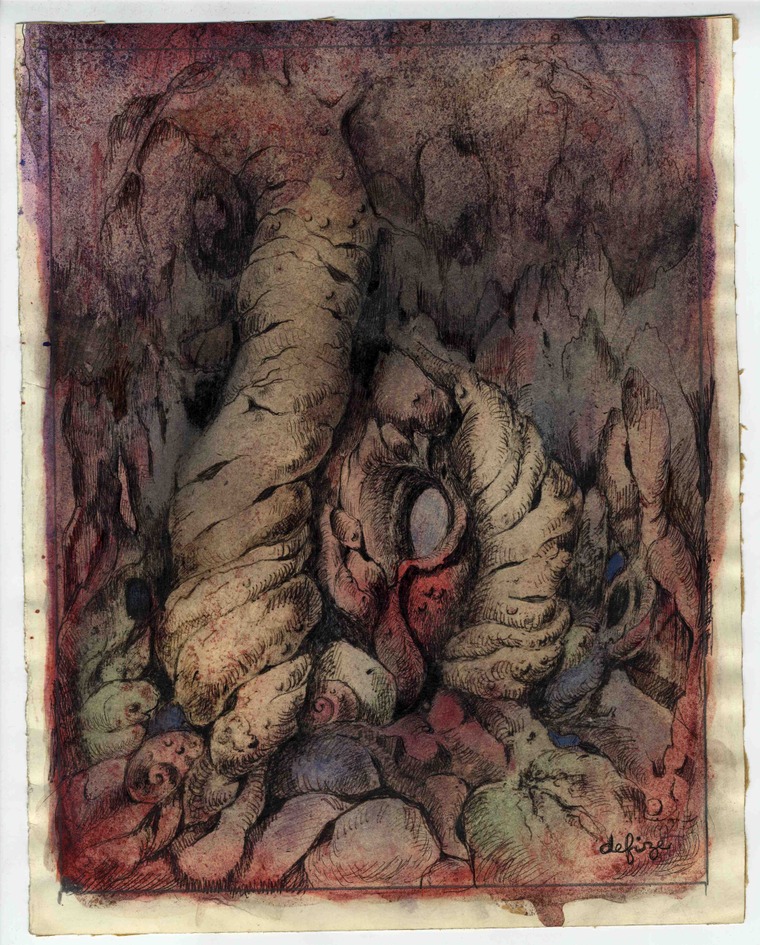
Her personal universe explores, among other things, the secrets of the mind and the realm of the marvellous. Several of her fantastic landscapes are desolate, while others are inhabited by strange beings at the crossroads of the mineral and the living. A mysterious, and at times even unsettling, atmosphere emerges. The Fine Arts collections of Liège preserve several examples (fig. 1).
If one dares a comparison with the science-fiction horror series Stranger Things, she paints her own “Upside Down World”, populated by her personal “Demogorgons”.
Recreating the primal state, the origin
Carmen Defize’s reflections are nourished by the writings of the evolution theorist Pierre Teilhard de Chardin (1881–1955). She was interested in the evolution of forms and in the origin of matter, eventually transcending them by allowing herself to be guided by what she called the “powers of the unconscious”.
By day, she fulfilled her professional and family obligations. When others went to bed or were already dreaming, she finally devoted herself to art. For her, it was an outlet where her cries became matter. She confessed that, at such moments, the subconscious took over and guided her hand. She expressed an anxiety that was both artistic and existential, which she described as a “resigned anxiety”.
The donation
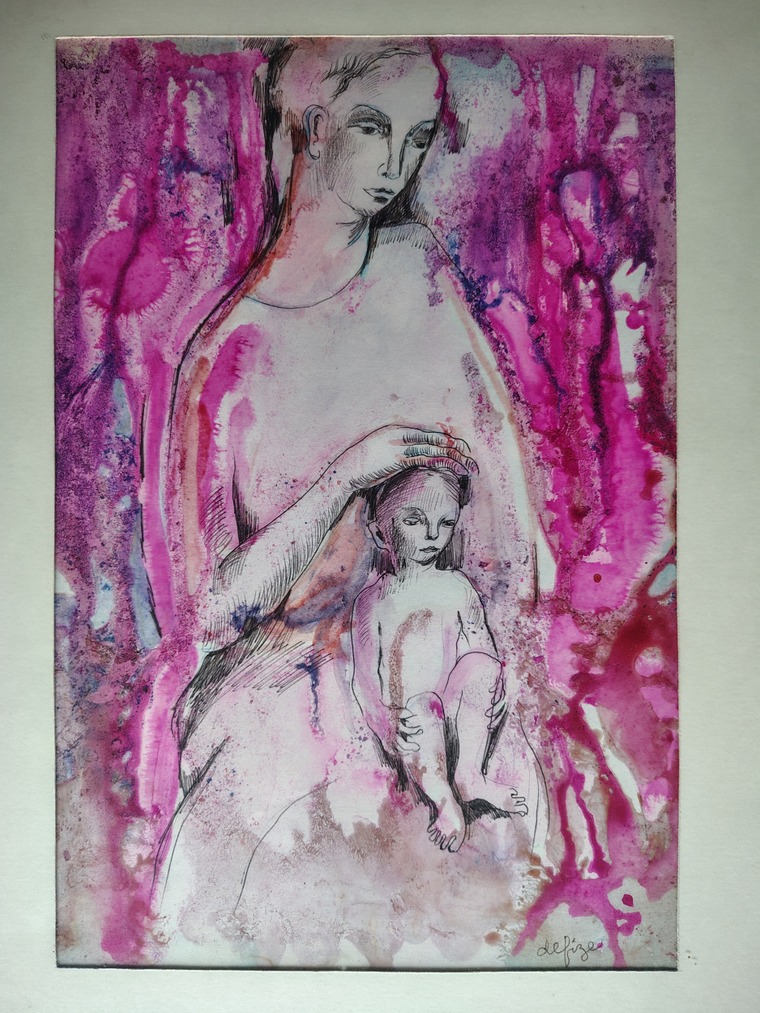
The artist explored the subject of motherhood through various facets and techniques, as evidenced by other works still held by her family (fig. 2).
Originally, the painting exhibited here bore the title Tenderness. It gently depicts the relationship between a mother and her child. This Virgin and Child draws its strength from an apparent simplicity: the figures are stripped of all artifice, and matter becomes gesture.
Regarding this work, which was particularly dear to her, Carmen Defize stated that it summed up a large part of her life. In 1988, the donation of this “Virgin of Tenderness” enriched a long tradition of Marian iconography, which until then lacked a representative of the 20th century within the former Museum of Religious Art and Mosan Art, now integrated into the Grand Curtius museum complex.
By Christelle Schoonbroodt
Grand Curtius Museum
Curator of the Department of Religious Art and Mosan Art