Work of the month - Michel François
February 2026
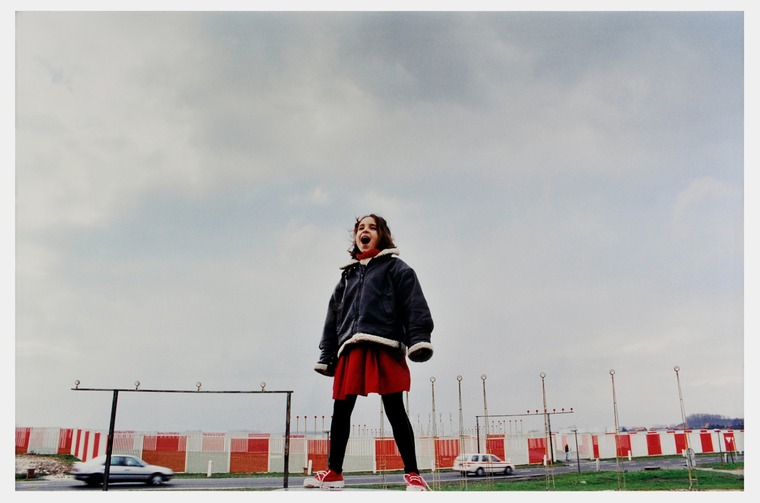
Leone à l’atterrissage des avions
Michel François (Saint-Trond, 1956)
Photographie, 1999
200 x 165 cm
Acquis par la Ville de Liège en 2009
N° Inv. : AM 1024
‘Most of the time, looking is not enough to understand the world; you have to put your whole body into it.’
Michel François
Michel François was born in 1956 in Sint-Truiden. His training reflects the multifaceted practice he would later develop. He was first introduced to theatre at the Institut national supérieur des arts du spectacle (INSAS) in Brussels, then graduated from the École de recherches graphiques (ERG), and went on to teach at the École des Beaux-Arts in Paris. This transdisciplinary background explains his sustained interest in the body, space and staging.
An internationally recognised artist, Michel François participated in major contemporary art events from an early age. He was invited to Documenta IX in Kassel in 1992, represented Belgium at the São Paulo Biennial in 1994, then at the Venice Biennale in 1999 alongside Ann Veronica Janssens, curated by Laurent Jacob (Espace 251 Nord, Liège). Between 1990 and 2000, he also participated in several international biennials, notably in Rennes, Istanbul, Seoul and Shanghai.
At the same time, his work has been featured in numerous solo and group exhibitions at leading institutions, including the Palais des Beaux-Arts in Charleroi (1999), the Kunsthalle in Bern and the Haus der Kunst in Munich (2000), the Joan Miró Foundation in Barcelona (2001), the Centre Pompidou in Paris (2002), the Westfälischer Kunstverein in Münster (2003), the Museum De Pont in Tilburg and ArtPace in San Antonio (2004), the MACBA in Barcelona, the Musée des Beaux-Arts in Lausanne and the SMAK in Ghent (2009), the IAC in Villeurbanne (2010), the CRAC in Sète (2012), the Mac's in Grand-Hornu (2016), YARAT in Baku (2022) and Bozar in Brussels (2023).
An explorer of media, Michel François has developed a deliberately heterogeneous body of work, structured by a constant relationship with the image as a means of capturing reality. Life, considered in its most ordinary manifestations as well as in its states of tension or transformation, forms the core of his artistic research. Adopting a stance similar to that of an anthropologist, he observes everyday situations, mundane gestures and transitory states, which he isolates and renders perceptible through framing, displacement or distancing. This attention to the ordinary allows him to bring to light what usually remains invisible. For the artist, “art is life sculpted”: in Michel François's work, photography functions according to a sculptural logic, freezing a state of reality while questioning space, volume, the relationship between masses and the organisation of forms.
In Leone à l’atterrissage des avions, the artist's daughter stands on the roof of a car. Wearing red trainers, she appears to be shouting with enthusiasm and visually dominates the scene. Her posture, simultaneously confident and unstable, creates a sense of suspension. In the background, a red and white fence evokes the proximity of an airport; the runway and planes remain off-camera, activating an imaginary space left to the viewer's imagination. The title introduces a minimal narrative element: the child is waiting for a plane to land, an event that is absent from the image but constitutes its tension.
As in many of Michel François' photographs, the subject is directly linked to what is materially and emotionally close to him. However, the image is not reduced to an intimate anecdote. It brings into play a tension between the private sphere and public space, between individual experience and a collective environment governed by norms. The photograph deliberately leaves several questions open and presents itself as an interrupted, condensed narrative fragment that suspends the gaze and calls for active interpretation.
Created for the 1999 Venice Biennale, Leone à l’atterrissage des avions was initially distributed in the form of 5,000 posters made available free of charge to visitors. This mode of presentation, recurrent in Michel François's approach, is based on the circulation, appropriation and possible recontextualisation of images by the public. Devoid of any mention of the author or commentary, these posters, made of multiple and deliberately precarious materials, were intended to be taken away, disseminated and reused in unpredictable ways. The print preserved in the City of Liège's collection, produced on silver halide paper, bears witness to the complex interplay of scales and statuses that the artist establishes, between mass distribution and heritage object, between the ephemeral and the lasting.
Edith Schurgers
Special Assistant to the Museum Events Department
La Boverie - Museum of Fine Arts
According to the entry by A.D. and E.S. in La Boverie, catalogue of the collections of the Musée des Beaux-Arts de Liège, Ghent, 2018, pp. 288 and 289.