Work of the month - Auguste Mambour
February 2025
Mambour or the choice of a dream Africa
Auguste Mambour (Liège, 1896-1968)
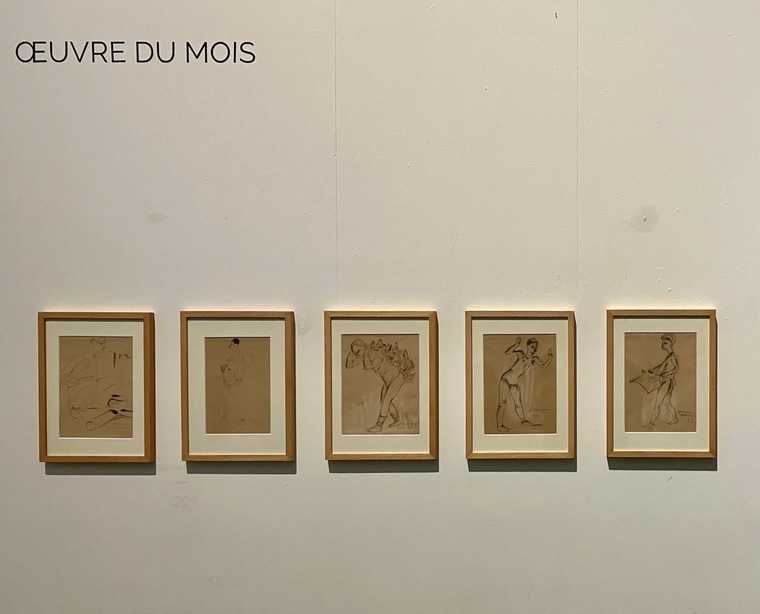
Set of drawings in pencil, Indian ink and wash
1923, 26 cm x 20.5 cm
Acquired in 1970 by the City of Liège
Collection of the Cabinet des Estampes et des Dessins of the City of Liège
BA.CED.23a.1970.003755, 003747, 003750, 001897, 001898
It all began in 1922 when the painter Auguste Mambour, then aged 26, was awarded Belgium's second Prix de Rome, considered at the time to be the ultimate accolade (1). This prize, created in 1832 on the French model, rewarded winners with a grant enabling them to further their training by travelling to Rome to copy the masterpieces of the Italian Renaissance: Michelangelo, Vinci, Raphael and other undisputed great masters (2).
Mambour, already described at the time by his biographer Jules Bosmant (3) as a ‘cursed painter, a non-conformist, a revolutionary who excelled at scandalising the bourgeoisie’, had no interest in this destination imposed by the rules. He claimed to ‘already know Italy too well: I have postcards of the Quattrocento... and here are Cimabue, Giotto, the whole of Raphael in volumes’ (4). He decided to travel to the Congo - a highly unlikely destination in the first half of the 20th century - to learn about ‘negro art’. His decision provoked a heated debate within the selection committee: ‘What a scandalous audacity for a Westerner, heir to the Renaissance and the Judeo-Christian tradition, to have dared to celebrate negritude’ (5). ‘Regulations force you to go to a foreign art country. The Congo is not an art country, nor is it a foreign country because it is a Belgian colony. Give the money back’ (6) Mambour ignored these accusations and, on 16 April 1923, embarked at the port of Antwerp (7).
Thanks to the notes and inscriptions in the sketchbooks, we can retrace Mambour's route: he arrived in Boma, travelled to Matadi and then Kinshasa by train. He followed the rivers to Kisangani, where he stayed for a month. He then took a pirogue down to Yanongé and travelled by caravan through the Maniéma, Lusambo and Lunbefu regions.
He crossed the Sankuru river to return to the mouth of the Congo river via the banks of the Kasai. Loaded with trunks full of souvenirs, sketches, notes and around fifty paintings, he landed in Antwerp in November 1923. The journey would last six months.
The painter realised his dream: ‘To see simply, without school prejudices, and to paint in an almost untouched nature’ (8). The equatorial forest impressed him, but he did not paint Congolese landscapes. All his attention was focused on the inhabitants, the men and especially the women, and their habits and customs: ‘I visited tribes of magnificent types, where the women are so beautiful that it would have been enough to marble their bodies to turn them into pure Greek Venuses (...).
The splendour of the human body moving freely was the goal I had set myself when I decided to go to the Congo’ (9).
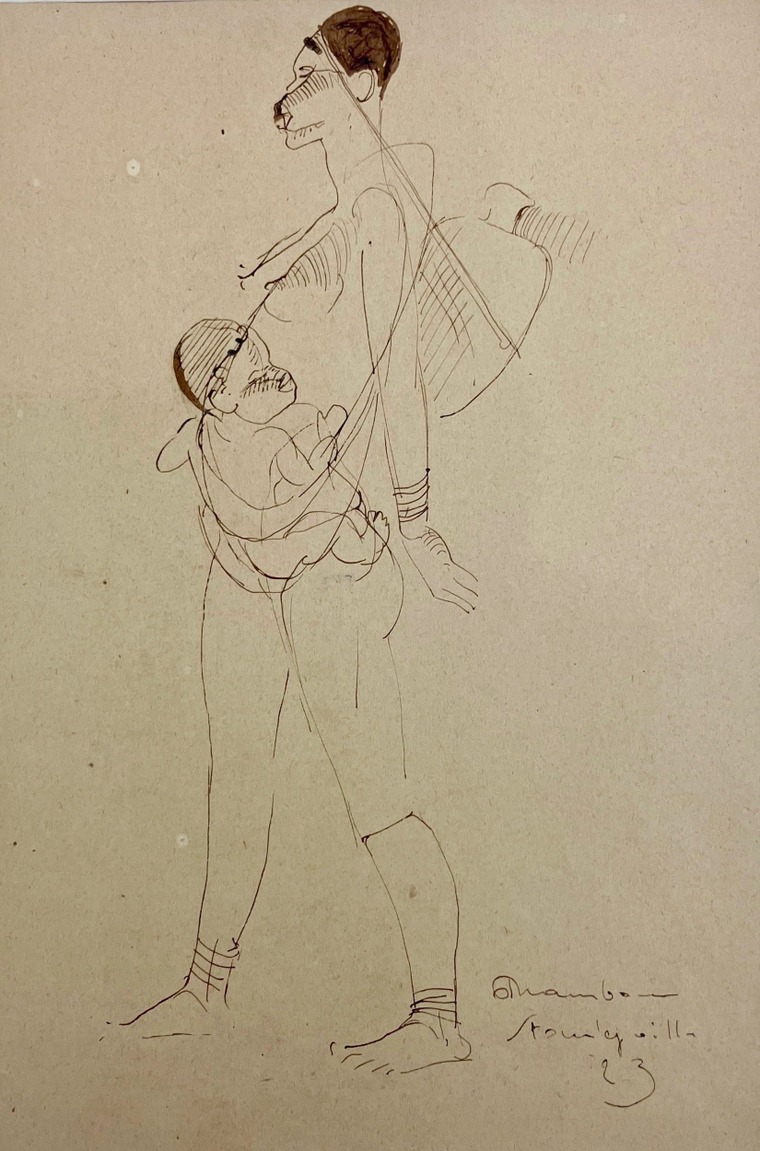
Eleven drawings were acquired by the City of Liège in 1970. They were all in the same format, signed and often dated June 1923, with the occasional inscription indicating the place. They all show the artist's interest in the body, mainly female, in movement and in everyday occupations: dancing, playing a percussion instrument, carrying a heavy bunch of bananas on her back or a child slung over her shoulder or on her hip, or sitting in front of a pottery piece. These bodies are naked, dressed only in a loincloth and sometimes adorned with a few anklets. As for the faces, they are rendered by a few lines accentuating the prominent chin, the thick lips, the broad forehead, the hair in the shape of a bonnet or pulled back into a crest. There is no superfluous detail or element that would situate the setting, and no room for exotic picturesqueness. The artist's confident, supple brushstrokes retain only the essentials. The sketches are not enhanced with colour, just diluted sepia ink and black pencil.
But as for the paintings on canvas, Mambour, faithful to his range dominated by bluish greys, declared: ‘The Congo is blue. So are negroes. For those who can't see, blacks are black. For those who can see a little, they are brown; for those who can see rightly, they are blue (...) The blue Congo. It seems like a fairytale...’. (10).
Deeply affected by this encounter with the African people, he went so far as to suggest that his fellow painters, too stuck in their conventional world, should follow his example: ‘Many painters can go and take lessons from these native craftsmen. They'll learn to get rid of the marshmallow that spoils their work. (11) André Hallet, Adrien Dupagne, Paul Daxhelet and Ianchelevici followed in his footsteps.
What would have become of Mambour's artistic career if he had obediently gone to Rome instead of Africa? Chances are that the artist would have been more attracted by Michelangelo's sculptural figures than by Raphael's Madonnas, and that his subsequent output would have been somewhat different. But Italy would probably not have got the better of his rebellious nature, his need to get off the beaten track. References to the Congolese period would be found many years later in his paintings, such as the ‘Iron Nude’ in the municipal collections, dated 1933.
Régine Rémon
Honorary Curator / Musée des Beaux-Arts de Liège
Bibliographical notes
This text is largely based on an article published in 2010 as part of the exhibition ‘L'Afrique rêvée’ organised by Jean-Pierre De Rycke at the Musée des Beaux-Arts in Tournai: Régine Rémon, ‘Auguste Mambour: au Congo, tout est harmonie’, published by Racine, Brussels, 2010, pp.15-17 and 112-114.
(1) That year, first prize was awarded to Marie Howet, a painter from the Ardennes. Only one painter from Liège would win the first Belgian Grand Prix de Rome. This was Henri Brasseur, a pupil of Mambour, in 1942.
(2) In Liège, another foundation, created in 1696, enabled artists to benefit from training in Rome: the Darchis Foundation, which is still active today.
(3) Jules Bosmant, ‘Auguste Mambour’, Monographies de l'art belge, ed. Meddens, 1965, p.12.
(4) Michel Pirotte and Jean Guy Gilles, ‘Auguste Mambour, L'odyssée d'une œuvre en trois dimensions’, La Renaissance du Livre, Tournai, 2003, p.132.
(5) Jacques Parisse, ‘Mambour, une œuvre, un destin’, ed. Labor, Brussels, 1984, p. 8.
(6) Michel Pirotte, op. cit. p. 133.
(7) The rules were gradually relaxed: while they still required the purse to be used for travel purposes, the destination was no longer compulsory.
(8) Michel Pirotte, op. cit. p. 132.
(9) Michel Pirotte, op. cit. p. 140.
(10) Michel Pirotte, op. cit. p. 140.
(11) Michel Pirotte, op. cit. p. 132.