Our Works of April
THE GREAT EXPANSES OF JEAN PAUL RIOPELLE
L'ETOILE NOIRE, A GRAPHIC BIO
THE GREAT EXPANSES OF JEAN PAUL RIOPELLE
Jean Paul Riopelle (Montreal, 1923 - L'Isle-aux-grues, 2002)
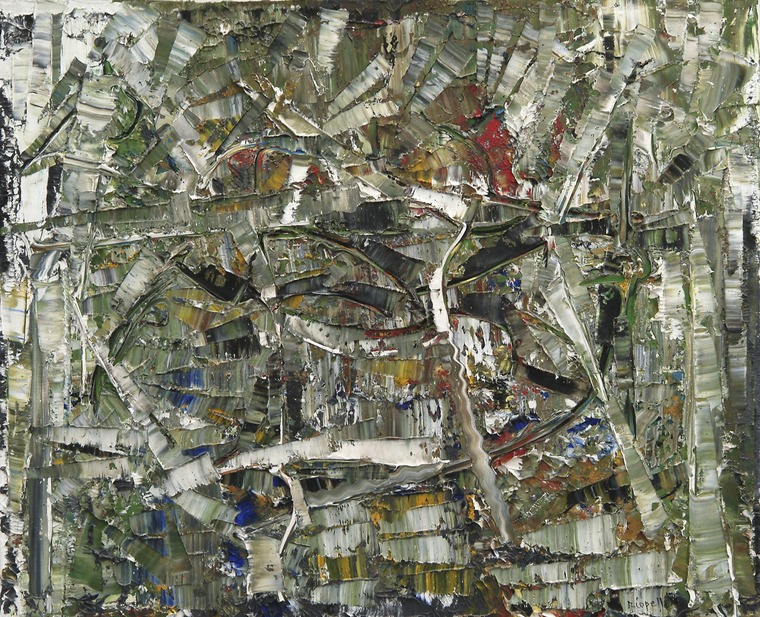
Madawaska, 1975
Oil on canvas,
81 x 100 cm
Inv. BA.WAL.05b.1981.21686
Donated by Fernand Graindorge in 1981
Deposit of the Fédération Wallonie-Bruxelles
A prolific Canadian artist, Riopelle tried his hand at all techniques: painting, engraving, sculpture... Travelling from figuration to abstraction, he lives between Paris and his native Quebec. At a very young age, artist Henri Bisson taught him the rudiments of the trade. He painted mainly landscapes, figures and still lifes. From 1942, he trained at the Ecole des Beaux-Arts de Montréal and the Ecole du Meuble.
He joined the Automatistes the following year. Based on the foundations of Surrealism, this group of artists broke away from it by giving priority to an intuitive approach to creation. From a formal point of view, their works approached lyrical abstraction. In 1947, he moved to Paris and became a regular visitor to leading local artists. He signed the text Rupture inaugurale, in solidarity with André Breton and the Surrealist group.
The 1950s was the decade of "mosaics", characterised by spatula work creating impastos of juxtaposed colours. The material is literally sculpted, and its expressive force is reinforced by a sustained, lively rhythm. Recognised for his talented creations, the artist exhibited at the Venice Biennale in 1954, in São Paulo, and Pierre Loeb, a famous Parisian gallery owner, bought a large part of his work. This high profile was his first recognition.
His success continued in the 1960s, and several exhibitions were organised both across the Atlantic and in France. He then received a remarkable commission for Toronto airport for a large canvas entitled Meeting Point (426 × 549 cm). It was his largest format. The Canadian government donated it to France in 1989, to mark the bicentenary of the French Revolution. It is currently at the Opéra Bastille. At the end of the decade, he turned to sculpture and introduced animal figures into his work. In 1967, the Musée national des beaux-arts du Québec organised a major retrospective of the artist's work.
During the seventies, Riopelle diversified his technique and regularly painted on paper, without abandoning his work on canvas. He also took up ceramics in collaboration with Hans Spinner. He continued to explore this technique until 1984-1985. The following year, his daughter set about compiling a catalogue raisonné of his work. In December 1991, the Montreal Museum of Fine Arts presented a major retrospective, while the artist worked mainly in Canada. Jean Paul Riopelle died on 12 March 2002 at his home on Isle-aux-Grues. A state funeral was held in his honour.
Madawaska
The work in the collections of the Musée des Beaux-Arts is entitled Madawaska and dates from 1975. It uses a technique known as "mosaic", in which coloured impastos interweave to create a rhythmic, relief-like composition. Madawaska is a region in north-eastern North America, between the USA and Canada. French is spoken here, and the landscape is characterised by vast stretches of forest. Without detailing the contours of a clear-cut landscape, the oil on canvas Madawaska evokes these primitive, dense forests through its dominant shades of green and its work on the material. The shimmering colours are reminiscent of the autumnal tones characteristic of these lands. Divided between his studio in Paris and his studio in Sainte-Marguerite, a suburb of Quebec City, the painter depicts the landscapes that are so dear to him and that are barely a hundred kilometres from his studio.
The Graindorge collection included some ten works by Jean Paul Riopelle, from a 1955 watercolour to Madawaska, which was deposited with the Musée des Beaux-Arts de Liège in 1981.
Grégory Desauvage
Curator / Musée des Beaux-Arts
L'ETOILE NOIRE, A GRAPHIC BIO
Marc-Renier (Cologne, 1958) & Philippe Girard (Quebec, 1971)
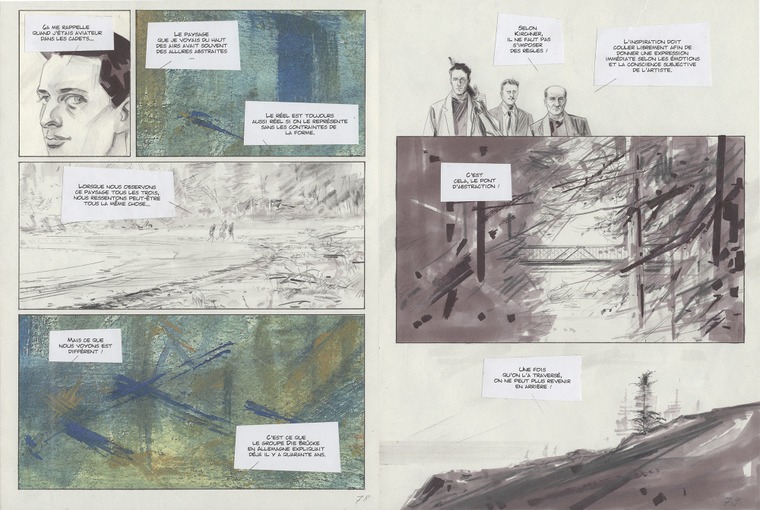
L'Etoile Noire, plates 74 to 79, 2024
Mixed media (graphite, Winston & Newton cold grey markers, acrylics) on Canson paper, 28.3 x 21 cm
Property of the artist, on loan to the Fonds patrimoniaux/Archives de la bande dessinée
Comic strip authors Marc-Renier and Philippe Girard met for the 2019 Quebec Comics Festival. Marc-Renier has been scouting the region for an album, and returns to Quebec City in the summer for a residency. The project for L'Etoile Noire then took shape: a comic book dedicated to Jean Paul Riopelle, whose centenary the Quebec cultural scene is preparing to celebrate, but also to Paul-Émile Borduas, his teacher and rival. L'Étoile noire is also the culmination of Quebec artist Philippe Girard's residency in Belgium in 2022. A synthesis of the relationship between Riopelle and Borduas, this book also crystallises the encounter between two worlds of authors who merge for the time of a story and celebrate the Belgian-Quebec friendship. In March 2024, Marc-Renier completed a 180-page graphic novel. To serve Philippe Girard's finely-chiselled script perfectly and convey its historical and artistic accuracy, he returned to all the plates in successive waves.
The story begins in 1943, when Riopelle was a young student at the École du meuble de Montréal and met Paul-Emile Borduas. The two men quickly became friends, united in their desire to break the social shackles that were suffocating Quebec. With the Automatistes, they signed Le Refus global in 1948. This manifesto, radically opposed to the traditional values prevalent in Quebec culture and society, was already the spark for the Quiet Revolution, which would bring Quebec into the modern age. As a result, Borduas was expelled from the teaching profession and exiled to the United States, while Riopelle was in Paris at the height of his career.
The narrative of L'Etoile Noire, of which plates 74 to 79 are presented here, is built around these mirror-image trajectories. The sequence is set in Saint-Fabien-Sur-Mer, in 1944-1945, a pivotal period in the young Riopelle's development, as he abandoned the academic style he had learned from his teacher Henri Bisson and became increasingly influenced by Paul-Émile Borduas. To express his point, the transition between figuration and abstraction, Marc-Renier uses the six cool grey tones of Winston & Newton markers. Their double point, one of which is bevelled, allows him to translate the painter's gesture into his line, while the acrylic colours of the canvases stand out against the storyline. Between substance and form, the ever-vibrant material of L'Etoile noire takes shape, due to be published in 2024 by Mains libres in Montreal.
Fabien Denoël
Curator / Fonds patrimoniaux de la Ville de Liège