Work of the month – Christiane Willemsen
October 2025
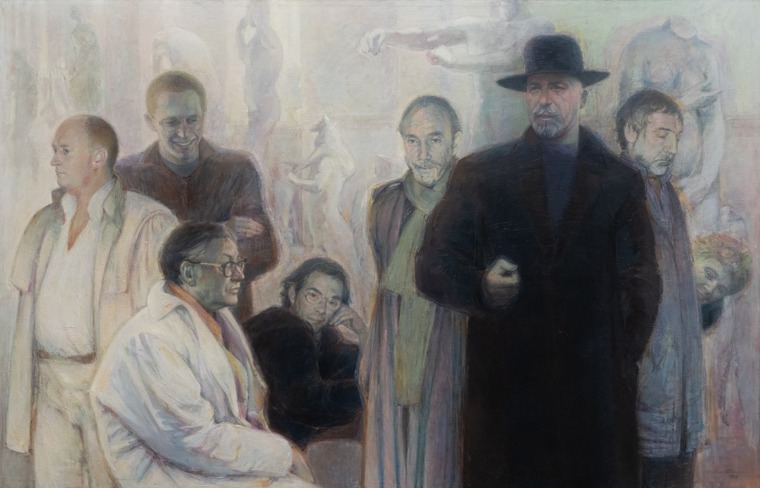
Sept collègues pour un tableau.
Christiane Willemsen (Liège,1935 –2025)
Professeurs de l’Académie de Liège
Huile sur toile, 1989
129,5 X 200,5 cm
Donation à la Ville de Liège en 2018
Inv. BA.AMC.05b.2018.005540
There are seven of them. Seven teachers. Seven colleagues. They teach drawing, painting and colour. All of them are painters. You can recognise the dark silhouette and hat of Freddy Beunckens, the profile of Alain Denis on the far left, the smile of Yves Bage, the face of Willy Gasquis in the foreground, that of André Dejardin, his head resting on his hand, the standing figure of Jean-Marie Tack to the left of Freddy Beunckens and, on the right, the pensive and reserved face of Jo Rome. Seven male colleagues, joined on the far right by the slightly mischievous smile of Christiane Willemsen herself. An amused tribute to friends, colleagues and, of course, an institution, the Académie de Liège, where they all taught. An institution to which the barely sketched silhouettes of plaster copies of antiques also allude.
The artist
Christiane Willemsen (1935–2025) was born in the Chartreuse neighbourhood in the hills above Liège, a neighbourhood she never left. Her father was a schoolteacher, and she showed an interest in art from a very early age, so it was only natural that she enrolled at the Academy in 1952. And although Christiane Willemsen is known today as a painter and even more so as a drawing teacher, it was the classes of Marceau Gillard (1904-1987) that she attended. She trained in sculpture, accompanied by drawing classes given at the time by Henri Brasseur (1918-1981). After her studies, Christiane completed her training with a degree in art history before joining the Academy as a drawing teacher a few years later, in 1961.
Her teacher
Henri Brasseur's personality made a strong impression on Willemsen: from the moment they first met, they discovered that they shared the same temperament, the same humanism, the same curiosity and the same interests. Their sensibilities were in tune with each other, and their views on art were similar. Christiane had little interest in abstract art and always preferred careful and meticulous observation of reality. Reality, yes, but not necessarily that of the traditional model posing in the studio, rather a deferred reality: that of photography, magazines, television and cinema. For Willemsen, as for Brasseur, the lessons of the past cannot do without the contributions of the present. This is where the pretexts originate: a grey window in autumn, a child's gaze, the silhouette of an Indian, the dilapidated door of an old barracks, anonymous silhouettes passing each other or, as here, seven fellow teachers brought together by the virtues of painting.
Building
Christiane Willemsen's painting is a time-consuming exercise. The canvas is created on the basis of a captured image, a momentary glance. It then takes shape, is constructed, values are established, and the drawing is refined. The painting never “comes” all at once. Everything here is established in nuance. In patience. It is less a question of reproducing the right tone of reality suggested by memory than of creating a whole, of making a whole. Choosing the image, placing it in the frame, making choices, organising, distributing, but also, above all, harmonising: a nuance added here influences the perception of an area over there. Each part, each fragment, even a simple touch, a modest reflection of light, inevitably influences the whole. The slightest modification of one component can either enhance or compromise the chromatic balance. Cézanne's lesson, in a way. A subtle balance, the result of multiple adjustments that can take days or even months.
The image is thus constructed. Patiently. Constructed, as here, from photographic fragments captured and reassembled. The image is a moment of memory recomposed, the fruit of encounters and confrontations: an image blended from our blended world. In her painting, although she frequently draws on moments captured by the camera, video camera or even cut out from magazines, Christiane Willemsen does not proceed by ‘exclusion’; she does not isolate as a photographer would by cutting out from the visible, she associates, which is why there is ‘construction’.
She combines and blends, as if to better convey the experience of this plural world where the ancestral and the authentic cannot present themselves to us without the corrupt trappings of “modernity”. A heterogeneous world where sometimes the colours of Coca-Cola rub shoulders with Inca walls against a backdrop of the Altiplano, and where electric cables intrude among the bougainvillea and azulejos.
A disparate world where wild grass grows even between the slabs of the Temple. A composite world, but one that is deeply alive, irreducibly human and inevitably contemporary.
Philippe Delaite
Honorary Professor at the royal Academy of Fine Arts in Liège