Artwork of the month - Juliette Rousseff
November 2025
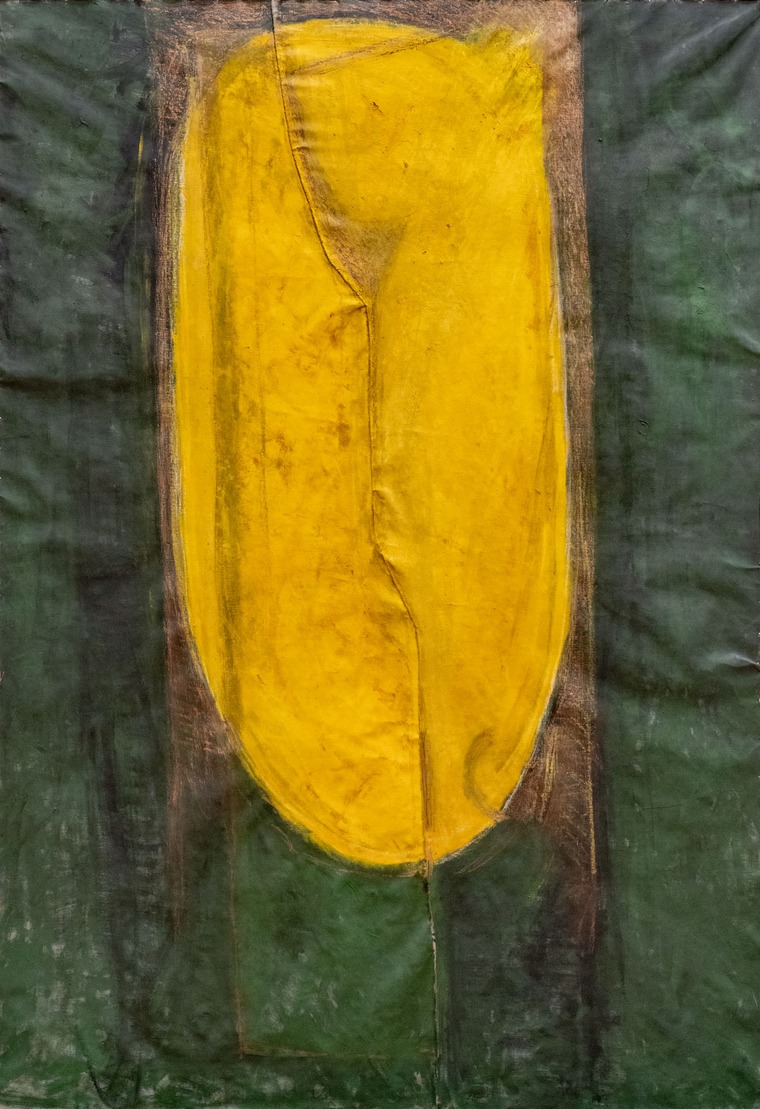
Tribute to Juliette Rousseff
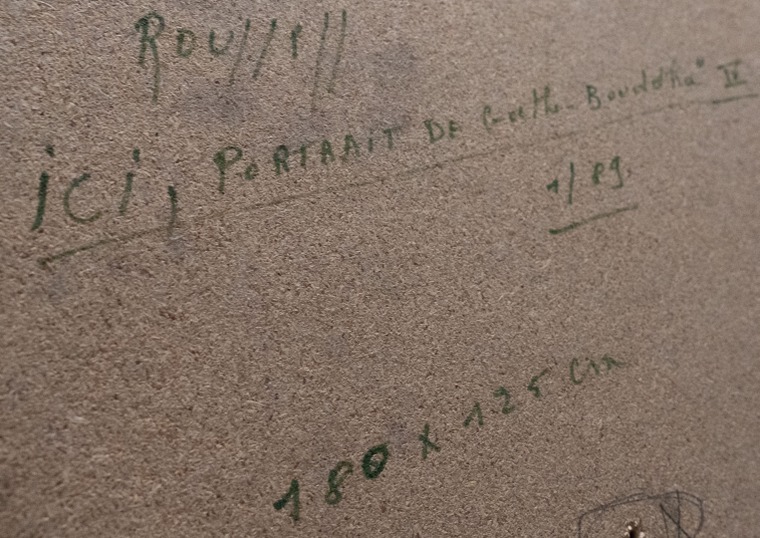
Portrait of Goethe Buddha IV (1989)
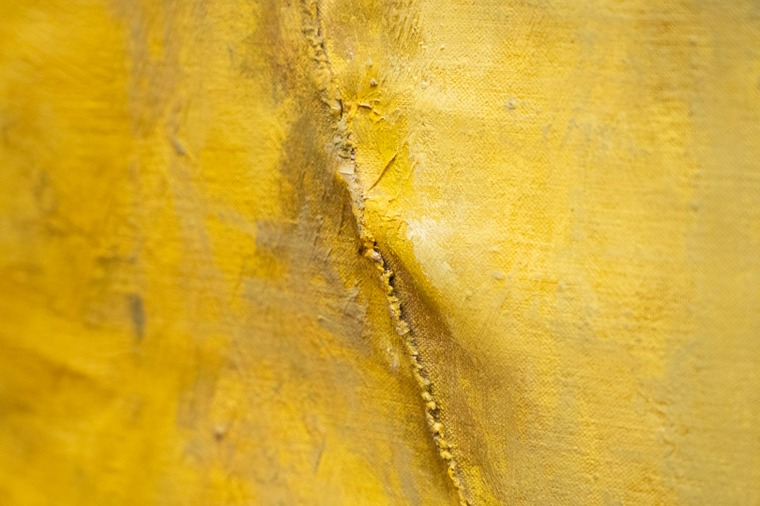
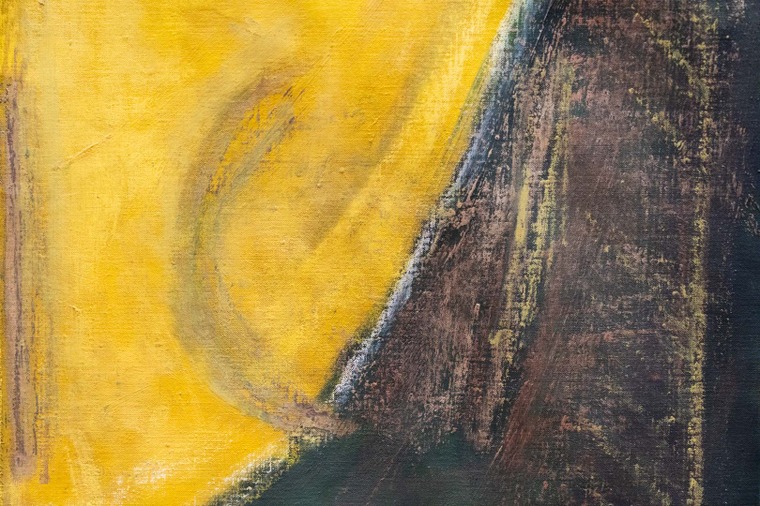
Oil on canvas and sewn fold, nailed to panel
180 x 125.5 cm
Purchased by the City of Liège in 1991
Inv. BA.WAL.05b.1991.2899
The artist :
Last October, Juliette Rousseff passed away, joining in a breath the other side of the world, the hidden world – to use her own words – the one she always sought to reveal through the light of painted space.
Juliette Rousseff was Slavic on her father's side, carrying within her the strength and sensuality of Bulgaria, making her passionate and generous, creating until the very end, with abandon, but revealing... Her mother, who came from a family of wool merchants in Verviers, which is no mere anecdote, gave Juliette an immense attraction to the velvety feel of fine materials and beautiful fabrics, such as the softness of silk, which gave her what she called the time of embroidery (incorporating time into pictorial space), which caressed her soul, as she herself testified.
Juliette is a Romanist, but she also graduated from the Academy of Fine Arts, which she ended up attending despite her parents' reluctance. She taught French for more than ten years and gave evening classes in the Textile Department of the Academy of Liège for nine years. But at the age of forty-three, she was dismissed by the administration because her degree was not equivalent to the required qualifications. She made the best of this absurd situation: ‘All these hassles,’ she said, "allowed me to find my way into art. I was able to explore it more deeply because I was fortunate enough to have the time and solitude. Between marking papers, it would have been impossible. I was penniless, but I was as free as a bird. To create, you have to be completely free.
Juliette Rousseff was married to Guy Vandeloise (1937), a visual artist and teacher who, like her, transposed his artistic forms into philosophical and existential reflections. Together, they created a foundation with the Province of Liège to which they gave everything: their works, their personal collections, their movable and immovable assets. However, the foundation does not bear their name, as it was their wish that it be dedicated to the arts in Liège and open to other artists who, like them, have a taste for research and a relentless quest for freedom in their creative work.
Her work
In her embroidered and pictorial work, Juliette has always sought to reveal the other side of reality, the secret hidden behind things as well as behind beings, and more particularly behind her own being, even if the painting exhibited here, Portrait of Goethe Buddha, reveals another portrait that combines two identities. It signifies the inner self of man, the invisible latent beneath the outer surface, a state of being such as ecstasy or their souls meeting, for Juliette has often sought to represent this vital principle, the movement that animates life (anima), the stitched fold bearing witness to the interstice between two states of being...
The act of painting, she says, is an attempt to connect the physical reality of matter to its mythical reality, through one's own body. It is to go to the reality of matter and collide with it (...). The heart of matter, identical throughout the universe, thus takes on the form of myth, since it is beyond our comprehension. She often develops her thoughts and her approach by quoting poets, philosophers and researchers, who are an inexhaustible source of reflection, reasoning and understanding of the world. And on this question of matter, she can refer as much to quantum physics as to Victor Hugo, who wrote: ‘Touch one atom and the whole universe trembles.’
Painting is also this desire to touch the body and heart of the other, which always elude us. It is eroticism in its purest form, she declares. Conversely, we can reactivate the great myths by bringing them to life, through the appropriate gesture, from the pictorial material. It is in this trilogy of material/gesture/figure of mystery that my journey takes place.
Isabelle Neuray
Coordinator, Province of Liège Foundation for Art and Culture
Bibliographie :
Juliette Rousseff, Les chemins de l’envers (2000-2010), Editions des Ateliers d’Art contemporain, 2011
Juliette Rousseff, L’Atelier intérieur (2011-2020), Editions de la Province de Liège, 2021
Guy Vandeloise Juliette Rousseff à la Boverie (catalogue d’exposition), Editions de la Province de Liège, 2018