Artwork of the month - Maurice Pirenne
May 2024
MAURICE PIRENNE OR SUSPENDED TIME
Maurice Pirenne
(Verviers, 1872 - 1968)
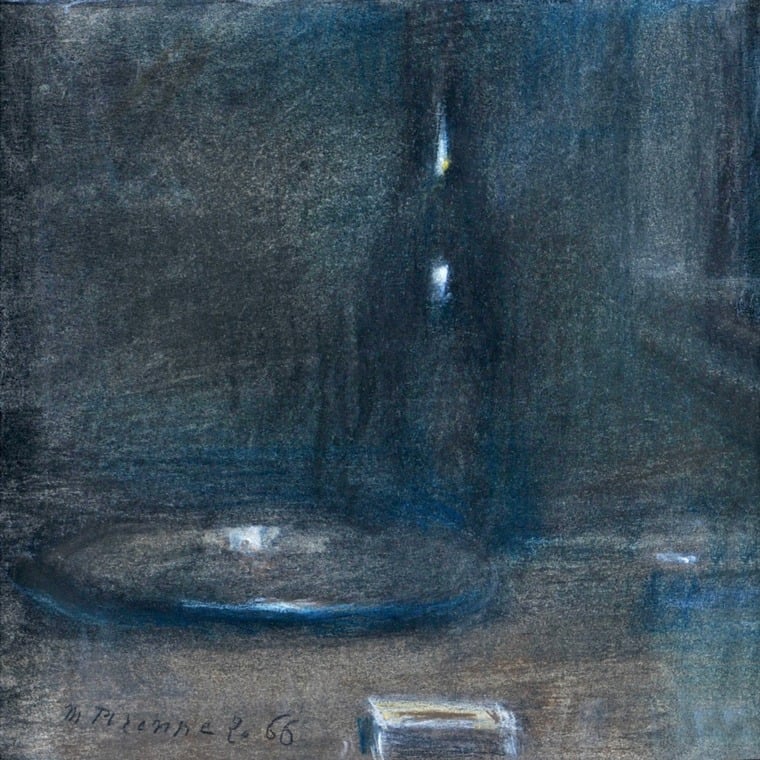
Bottle, plate and matchbox, 1966
Pastel on paper
22 x 22 cm
Inv. BA.AMC.23a.1986.000790-01
Blue, brown, black, a little green, all enhanced by a few white touches, a nervous drawing with slightly blurred lines to modulate the colours and a delightful still life emerges: a bottle, a plate, a box of matches and a frame that we can make out on the right-hand side, above the piece of furniture on which these everyday objects are placed. The overall effect is sombre, enlivened by the flashes of white that reflect the light on the objects depicted, and this small work is vibrant, alive, even if it emanates an impression of reassuring tranquillity, silence, simplicity and melancholy, as the genre - still life - has always given us, with Chardin and Vermeer being essential references for Pirenne.
Maurice Pirenne was born in Verviers in 1872. His father was an industrialist in the textile industry that made the town prosper from the late 18th to the early 20th century. His brother was to become the illustrious historian Henri Pirenne, and Maurice was destined to become a painter from an early age. Anti-academic, he rarely attended art school, taking a few drawing classes but honing his technique and eye by travelling to Ghent, Bruges, Paris and Brussels, where he visited museums and met many artists, including Degas and Ensor. Around 1900, he returned to his home town, where he remained until his death in 1968. From 1910 to 1948, he was the curator of the Verviers municipal museum, a role in which he devoted himself to defending the local heritage, while continuing to produce dozens of works, from the large early oils depicting the Fagnes in particular, to increasingly smaller formats - oils on canvas or cardboard, but also charcoal, pastels and pencils - evoking the past and the present, pastels and pencils - evoking corners of old Verviers that are gradually disappearing in favour of modern urbanisation, windows, lots of windows, half-open onto a balcony, an alleyway, the surrounding countryside, interior scenes, still lifes, bouquets of flowers and a few portraits and self-portraits.
Maurice Pirenne is generally associated with what some call the "Verviers School". We prefer "Les Intimistes verviétois", the tendency of a group of friends to depict landscapes or interior scenes in a sober style, a delicate rendering, a poetic and intimate vision. The group included Georges Le Brun - a youthful friend of Maurice Pirenne who died very young in 1914 during the First World War - Philippe Derchain, Joseph Gérard, Laurent-Léon Herve and others.
While each of these intimist artists has undeniable qualities, Maurice Pirenne seems to be the most radical of the group in his constructions, his original framings, his resolutely modern, cinematographic axes of view (even if the composition of the still life presented here is classic). Radical, too, in his position as an artist who paints only for himself, without any preoccupation with recognition, exhibitions or sales. He would undoubtedly have fallen into total oblivion without the determination of his friends, particularly André Blavier. Director of the Verviers library, but also a poet, a 'pataphysician, a friend of Raymond Queneau with whom he exchanged a rich correspondence, and the author of a reference work on 'Les fous littéraires', Blavier helped to make Pirenne's work better known by organising exhibitions and publishing, in 1954, 'Maurice Pirenne, 99 reproductions d'œuvres du peintre', for which he wrote a brilliant preface.
Fortunately, in recent years, museums (the Musée de Verviers, the Trinkhall Museum in Liège) and galleries (Galerie Nadja Vilenne) have been reintroducing works by Maurice Pirenne that collectors have been snapping up.
The acuity of this artist's eye, his way of capturing the detail in the whole, his meticulous observation, his rigorous drawing, without ostentation, and his hundreds of works make him - like his brother - the historian of everyday life for almost a century (he died aged 96).
Maurice Pirenne is remarkable in that each of his works eternalizes a portion of time.
Emmanuelle Sikivie
Art historian / Special attaché